


Each November, Chișinău gives five days to documentary, and this year the festival arrives with a question. The 11th MOLDOX International Documentary Film Festival runs from 25 to 29 November at Cineplex Loteanu under the title «Coexist?», an invitation to consider the possibilities and limits of living together amid conflict and polarisation. Sixty-three documentaries, forty of them feature-length, fill the official programme, among them No Other Land, the Academy Award winner for Best Documentary Feature, and Militantropos, one of two films that bring the war in Ukraine into the festival.
The festival also looks back. Agnès Varda receives the first retrospective in its history, with five works including The Gleaners and I and The Beaches of Agnès, and the second Green Vine Competition presents six documentaries by Moldovan filmmakers or Moldovan co-productions. Public discussions from 26 to 29 November start from questions close to Moldovan society, including the role of language in identity and the imperial past.
Around the screens, Andrei Moraru’s street photography exhibition Kilometrul Zero opens in the courtyard of Artcor on 26 November, and a concert by A P R O A P E at NØD Space follows on 27 November. The full programme is on the festival website.
Modern Times Review has written about several films that speak to the festival’s question.
No Other Land
Directed by Basel Adra, Hamdan Ballal, Yuval Abraham and Rachel Szor, No Other Land follows Adra, a Palestinian from Masafer Yatta, as he films army and settler actions in an area under demolition orders, with Abraham, an Israeli, beside him. Francesca Borri follows the film to the Berlinale, where Abraham’s talk of «co-resistance» brought accusations of antisemitism and death threats.
Militantropos
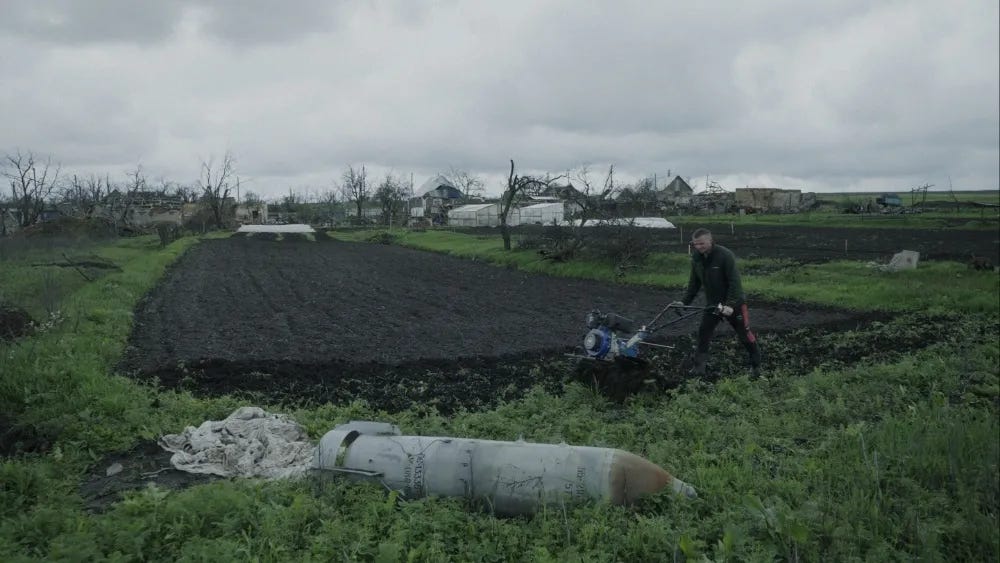
Yelizaveta Smith, Alina Gorlova and Simon Mozgovyi observe Ukrainians three years into a continuous war in Militantropos. Dieter Wieczorek reads its title, which joins the Greek roots for soldier and human, as a thesis about a new human type, with mass graves and choral singing in shopping centres sharing the frame.
Traces
Traces by Alisa Kovalenko and Marysia Nikitiuk, winner of the Panorama Audience Award at the Berlinale, follows women who survived rape and torture by Russian forces in Ukraine through their testimony and their activism with SEMA Ukraine, the network founded by Iryna Dovhan. Nick Holdsworth finds a film that turns toward hope.
Little Syria
Reem Karssli and Madalina Rosca filmed Little Syria over twenty years, and Bianca-Olivia Nita reads its fragmented structure as a mirror of Syrian lives ruptured by exile. It follows Reem, her brother Mohammed and her boyfriend Yasser, from a German court questioning Reem’s asylum status to the question of whether to look for a missing uncle.
A Song Without Home
Rati Tsiteladze’s A Song Without Home follows Adeline, a trans woman whose parents kept her confined at home for 11 years, between Georgia and Vienna after she wrote to the director in 2017. Melita Zajc finds in its minimalist visual language, with frames blocked by walls and doors, the hidden life Adeline was forced to lead.
Synthetic Sincerity
Marc Isaacs, the British director of Lift, lets an AI research group analyse interviews from his earlier films in Synthetic Sincerity, and the AI avatar of his Uyghur neighbour voices political positions the chef has kept silent about to protect his family. Aleksandra Biernacka reads the hybrid of documentary and fiction through Baudrillard’s simulacra.
Menopause Mystery
Louise Unmack Kjeldsen’s Menopause Mystery follows researchers who link menopause to brain health, and the story turns when Jayashri Kulkarni learns that The Lancet has dismissed the importance of menopause-related depression.
Follow Editor-in-Chief Truls Lie on Telegram and Industry Editor Steve Rickinson on Twitter. Join our Facebook Group, Modern Times Review, for an uncensored conversation on all things «Modern Times». And don’t forget to follow us on Facebook, Instagram, LinkedIn, X, and Bluesky.